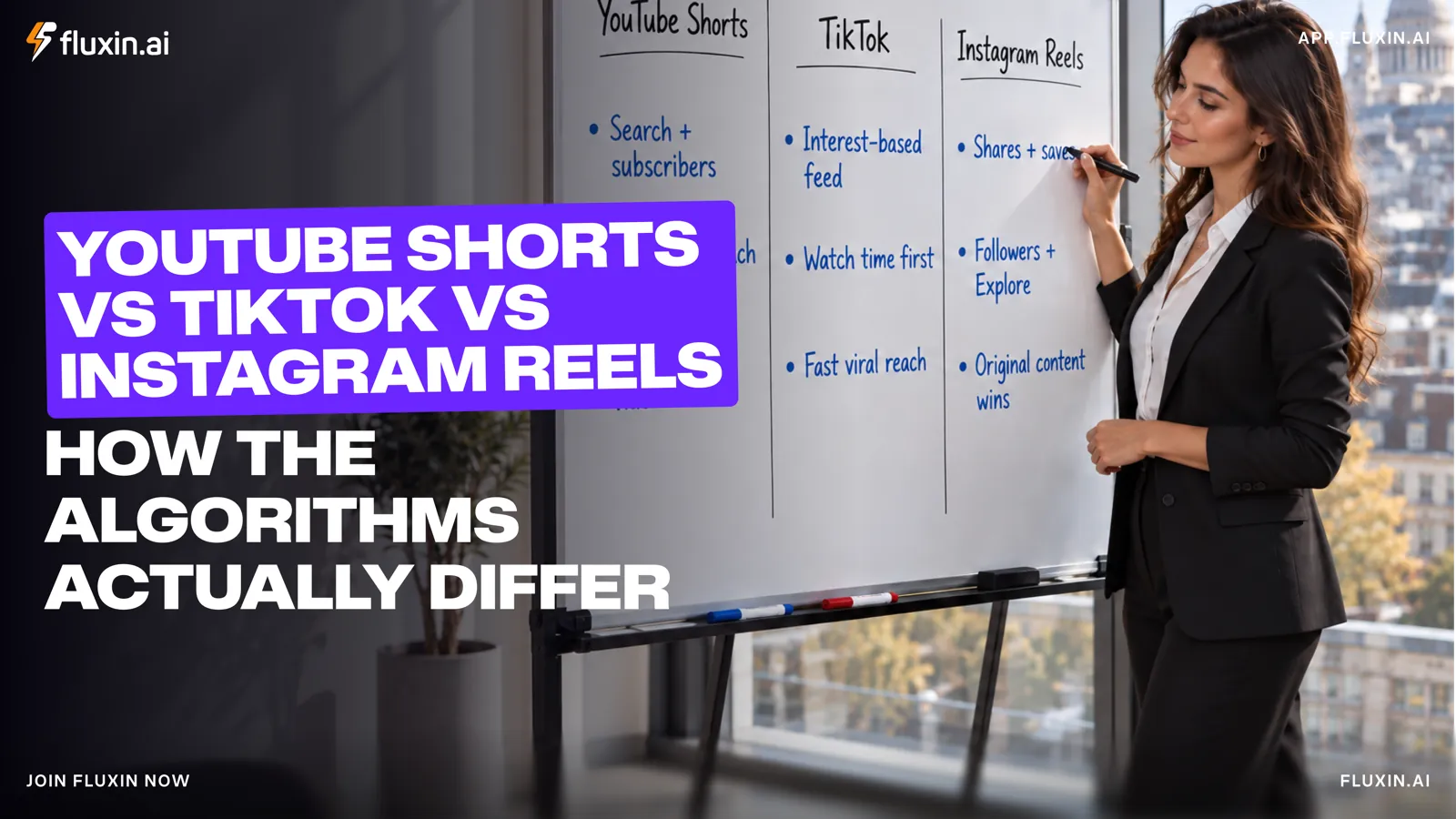
All three decide what to show based on how people react to a video rather than on who posted it. The real differences are narrower than they sound: who sees your video first, how much your existing followers count, and how long a video keeps being shown. TikTok leans towards discovery by strangers, Reels leans on the audience you already have, and Shorts rewards videos people watch instead of swiping past.
No platform publishes its full ranking formula, and all of them change regularly. Treat what follows as a practical read of what has been said officially and what the data suggests, not as a rulebook.
What do all three have in common?
Each one tests a video on a small group, watches the reaction, and widens the audience if the reaction is good. That single mechanism explains most of what people describe as algorithm luck.
It also means the same fundamentals carry everywhere: a clear hook in the first moment, a video that holds attention to the end, and something worth sharing or saving. Getting the opening right matters more than any platform-specific trick, which is the whole subject of making a 15-second video ad.
How does TikTok decide what to show?
The For You feed is built around discovery. It is designed to surface videos people might like from accounts they do not follow, which is why a brand new account can occasionally have something take off.
TikTok has said its recommendations are shaped by how people interact with videos, by details of the video itself, and by the viewer's own settings. Creators consistently report that watching to the end, re-watching, sharing and commenting all help. Follower count counts for less here than on the other two.
How does Instagram Reels decide what to show?
Reels surface in several places: the Reels tab, the main feed and Explore. Explore can carry a Reel well beyond your own followers, but Reels leans harder on your existing audience than TikTok does, which usually produces steadier and slower growth.
Instagram's leadership has said watch time and the number of people who send a Reel onwards are among the signals that matter. The exact weighting is not public, so treat it as a direction rather than a formula. It is one reason a video somebody wants to forward to a friend tends to travel.
How does YouTube Shorts decide what to show?
Shorts runs on its own system, separate from long-form video. YouTube has said a key signal is whether people watch a Short or swipe away from it, and that it has no preference for any particular type of Short.
YouTube has also said there is no minimum posting frequency and that each Short is judged on its own merits. Shorts frequently reach people who have never heard of the channel. Because they live on YouTube, they can also keep being found through search long after a video on the other two has stopped circulating.
How do the three compare?
| TikTok | Instagram Reels | YouTube Shorts | |
|---|---|---|---|
| Where it shows | For You feed | Reels tab, feed and Explore | Shorts feed |
| Who sees it first | Mostly people who do not follow you | A mix, leaning on your followers | Mostly people who do not follow you |
| Do followers matter? | Least | More than TikTok | Least |
| Signals reported | Watching to the end, shares, comments | Watch time, sends to friends | Watched rather than swiped away |
| Best for | Fast discovery | Keeping your own audience warm | Being found over time |
What does the data say?
Socialinsider's comparison of organic brand posts across TikTok, Reels and Shorts found differences large enough to be worth knowing about. Among accounts under 5,000 followers, average views per video came out at roughly 15,160 on Shorts, 625 on Reels and 350 on TikTok.
The same research put 2026 average engagement rates at about 2.60% for TikTok, 0.45% for Reels and 0.30% for Shorts.
Those two sets of numbers need handling with care, for three reasons. The platforms are measured differently, and TikTok's engagement figure includes shares while the Reels and Shorts figures count only likes and comments. The TikTok views figure is drawn from a separate benchmark covering a different period and describes the 1,000 to 5,000 follower band specifically. And all of them are averages across many brands, so your own account will not match them.
Shorts tends to hand small accounts a great deal of reach. TikTok tends to produce more engagement per view. Neither fact tells you what will happen to your video.
Use them to decide what to test first, then replace them with your own figures as soon as you have four weeks of them.
What should a small business actually do?
Make one good video and adapt it for each platform. Three separate ideas is not the job.
- Lead with the action. Put the most interesting moment in the first second or two, before anybody has decided.
- Keep it tight. A short video watched to the end beats a longer one people abandon halfway.
- Make it worth sending. A genuinely useful tip or a funny moment is what gets forwarded, and forwarding is a strong signal on all three.
- Export a clean version for each platform. Do not leave another app's watermark on a clip, since platforms generally do not favour obviously reposted content.
- Check your own numbers. Look at which platform sends actual enquiries rather than which produces the biggest view count, measured the way tracking results simply sets out.
Which platform deserves your attention first is a question about your customers rather than about ranking systems, and the honest comparison of TikTok and Instagram covers who is actually on each.
Where does Fluxin.ai fit in?
In the re-exporting, which is the part that turns one video into an afternoon. Fluxin.ai takes a single video, produces the version each platform expects and schedules it, so the same clip does not get cut three times. Your own time then goes on the hook and the real moment in the footage, which is the part nobody can supply for you.
See how Fluxin.ai reformats one video for every channel, or compare the plans.