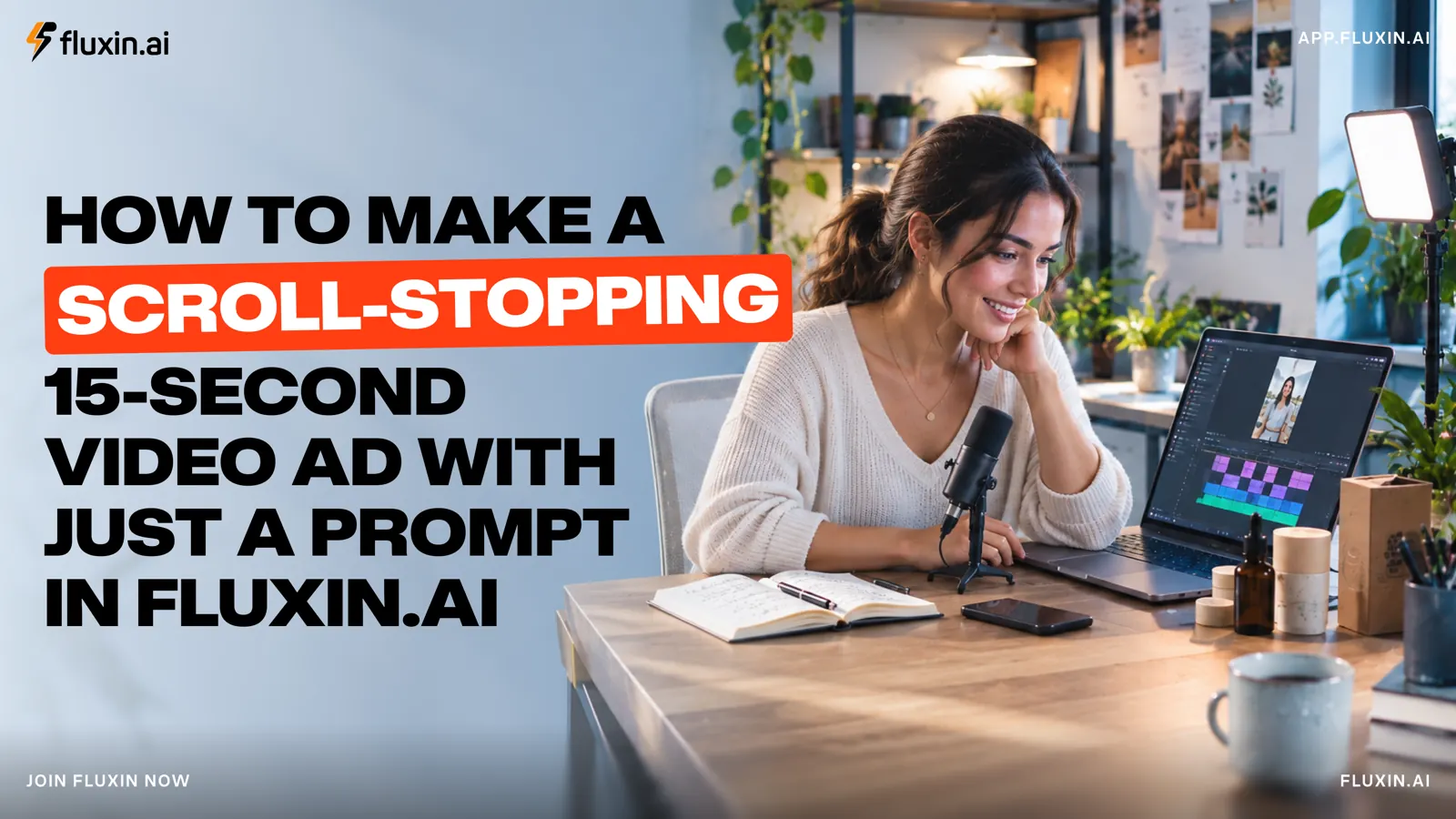
A good 15-second ad is one specific person doing one specific thing in one place, ending on a moment that holds still for a beat. Get those three right and everything else is polish, whether you are filming on a phone or generating the clip.
Most small businesses overcomplicate it. They try to fit in the price, the founding story, the logo and a call to action, and end up with a clip that says nothing at all. Here is the simpler method, and why it works.
What actually makes a 15-second ad work?
Fifteen seconds holds roughly one idea, one action and one spoken line. People speak at about 2.5 to 3 words a second, so a line landing in the final few seconds has room for about 7 to 10 words. "Same repair, half the wait" fits. A sentence covering your delivery policy and your origin story does not.
So pick one moment from your business and build everything around it. A bouquet being tied off, a parcel changing hands, a client finishing a final rep.
If you cannot describe the ad in one sentence, it is trying to do too much.
How do you hook someone in the first three seconds?
Start in the middle of the action. A hand already pouring, a door already opening, stems already being trimmed. Skip the establishing shot of the shopfront, because by the time it finishes they have scrolled past.
The same goes for the opening line. Something specific and faintly surprising ("Cut at 6am") beats something generic ("Welcome to our flower shop"). The first three seconds have exactly one job, which is to buy you the fourth. More on why that beat carries so much weight in maximizing small business growth on Instagram.
What should the prompt describe, and what should it leave out?
When you generate video from a still image, the clip animates forward from that exact frame. It cannot cut to a new location or introduce a scene that was not there, so the prompt only needs four things:
- Who: a specific role, such as "a mechanic in oil-stained overalls", not "a person"
- What they do: one action, such as "wipes a dipstick clean against a rag"
- Where: the place already visible in the image
- Camera: one simple move, such as a slow push-in
Leave out scene changes, long lists of events, and anything phrased as what to avoid. These tools respond better to what should happen than to what should not, so "the camera holds steady" works where "no shaky camera" does not. Fluxin runs this in two steps, a still first and then the motion, so the second prompt only has to describe movement.
Here is the difference in practice.
Vague: "Make an ad for my flower shop."
A florist in a canvas apron ties the final stem into a bouquet, turns it toward the window light and holds it there. The camera pushes in slowly and settles. Photorealistic petal texture, natural window light. Voiceover in English, warm and unhurried: "Cut this morning, in your hands by six." Continuous, seamless shot.
Closing with "Continuous, seamless shot" keeps it to a single take. Swap the florist and the bouquet for your own product and the shape holds, whether you are a mechanic, a baker or a steel supplier. We collected six reusable prompt shapes built the same way.
Why does the ending matter so much?
A clip that stops mid-gesture reads as a glitch rather than an ending. In our own testing, the clips that felt cut off shared one trait: the action was still going when the video stopped.
Finish on something complete and let it sit for the last beat. A bouquet set down, a cup slid across a counter, a product turned toward the light. That held moment is also where your one spoken line should land.
Why do captions matter if there is already a voiceover?
Plenty of people scroll with the sound off, so a voiceover on its own reaches only part of your audience. Put the hook on screen as bold text within the first second, and caption the spoken line.
Then think about where the clip is going. Reels, TikTok and Shorts all want vertical, and Instagram down-ranks anything carrying another platform's watermark, so export a clean version per destination rather than re-sharing one file everywhere.
How do you stop it looking obviously AI-made?
Specificity is the best fix available. "A florist" gives you a stock-photo florist. Name the apron, the stem she is checking, the thumb testing the stalk, and you get someone who looks like they are genuinely at work.
- Ask for realistic lighting and natural texture rather than "high quality", which means nothing to the model.
- Stay with simple physical actions in medium shots. They hold together better than fiddly close-ups of hands or complicated machinery.
- Aim for one believable moment, not a perfect one. Polish is what makes generated video read as generated.
That last point is the whole argument from why AI slop is real but not an argument against AI, applied to video.
The bottom line
One person, one action, one place, one line, one held ending. Everything else you were going to cram in belongs somewhere other than a 15-second ad.
If you would rather spend the time running the business than writing prompts, Fluxin generates the video, schedules it, and formats it for each platform. You bring the one real detail that makes it yours.
See how the generator and scheduler work, or compare the plans.