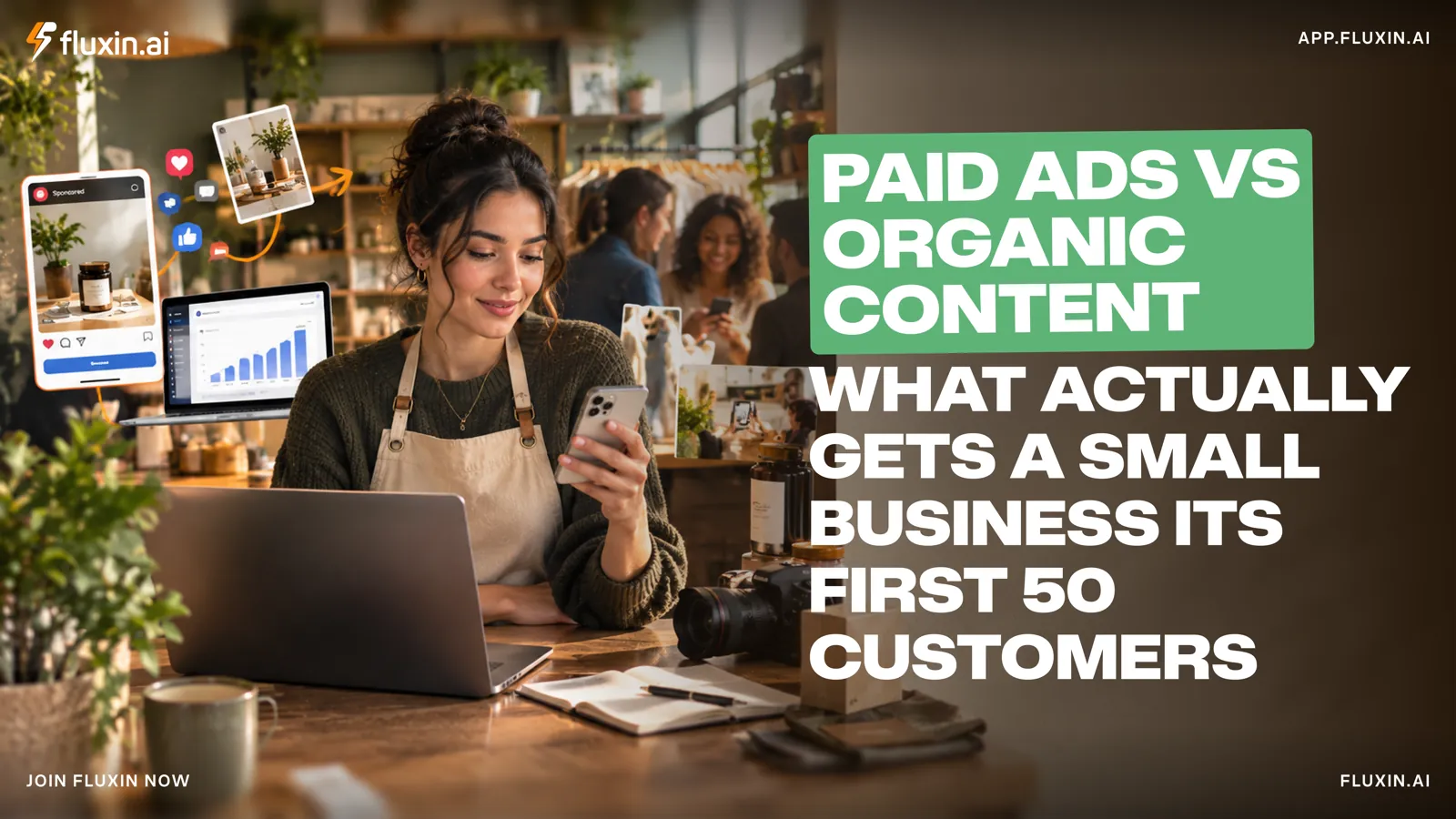
For most local and service-based small businesses, organic content gets you to your first 50 customers cheaper but slower, while paid ads get you there faster if you already have a proven offer and a well-defined audience to target.
A £15 haircut shop with a clear local radius is a better fit for paid ads than a handmade goods seller still working out who actually buys. That second business is better served by organic content while the offer gets validated.
The right answer depends on how proven your offer already is, not on which channel is generally better.
What actually works for the first 50 customers?
The first 50 customers are a different problem from customer 500. You are not optimising a funnel yet. You are proving that people will pay for what you are selling at all.
That favours channels where the feedback comes back fast and direct:
- A local Facebook group post that gets three comments asking about price
- A small boosted Instagram post that produces five DMs
- A referral from customer number one
Paid and organic can both deliver that. They just get there through different mechanics, and with very different waiting periods.
When does paid advertising get there faster?
Paid moves faster when you already know who buys and what they respond to.
Take a local delivery business with a known service radius and a £20 average order. It can often start seeing leads within days of launching a geo-targeted campaign, because the audience targeting does in an afternoon what organic content would need weeks to do through algorithmic discovery.
If your offer and audience are already validated, paid is frequently the faster route, because you are buying certainty rather than waiting for it.
When does organic content get there faster?
Organic wins when your offer is not validated yet, or when your budget genuinely cannot absorb the cost of testing.
A new product with an unproven audience tends to burn through ad spend on the wrong targeting before it finds the right one. Organic posts cost you time instead of money while you work out what resonates, which is a much better trade when the answer is still unknown.
A home baker posting daily in local Facebook groups and tagging happy customers can realistically reach 50 customers over two to three months without spending anything on ads, because word of mouth and local visibility compound in a way that does not require you to have nailed your targeting first.
| Your situation | Start with |
|---|---|
| You know who buys and why, and have budget to test | Paid |
| The offer is new and the audience is a guess | Organic |
| Tight budget, time available | Organic |
| Proven offer, need customers this month | Paid |
What does a realistic paid budget look like?
For a genuinely local service business, £10 to £20 a day tested over two to three weeks is usually enough to learn whether paid works for that specific offer, before committing anything more.
That number is small enough that a bad result is a cheap lesson. A good result gives you real figures, cost per lead and cost per customer, to decide whether scaling makes sense. Spending more than that before you have any signal tends to test your patience rather than your market.
What does a realistic organic timeline look like?
Expect weeks, not days. The pattern most small businesses see is four to six weeks of consistent posting before engagement starts compounding, then two to three months before that turns into a steady trickle of actual customers rather than likes.
The biggest risk to that timeline is not the strategy. It is the posting stopping around week three when the owner gets busy, which is the failure mode we wrote about in why most small businesses are solving the wrong marketing problem.
A scheduling and repurposing system is what prevents it, since the content keeps going out on the calendar you set regardless of how your week actually goes. Batching a month in one sitting is the practical version of that.
Can you combine both without spreading too thin?
Yes, and for many small businesses this is the real answer rather than a compromise.
Run organic as the always-on baseline that builds trust and social proof. Layer in a small, time-boxed paid test once you have a specific offer worth validating quickly.
The part people get wrong is that the organic side has to keep running whether or not the paid test is live. Testing a campaign should not mean your organic presence goes quiet for the three weeks you are focused on the ad. That is precisely why having the posting schedule and cross-platform repurposing already automated matters: the baseline survives your attention moving.
The bottom line
Neither channel is better in the abstract. Paid buys speed once you know what works. Organic buys the knowledge of what works, more slowly and more cheaply.
Start with whichever matches how certain you currently are, and keep the organic baseline running either way. If you are also weighing up who should be doing this work, the cost comparison between tools, agencies and doing it yourself covers that side.
See how the scheduler and ad launcher work, or compare the plans.